
THE BLOG
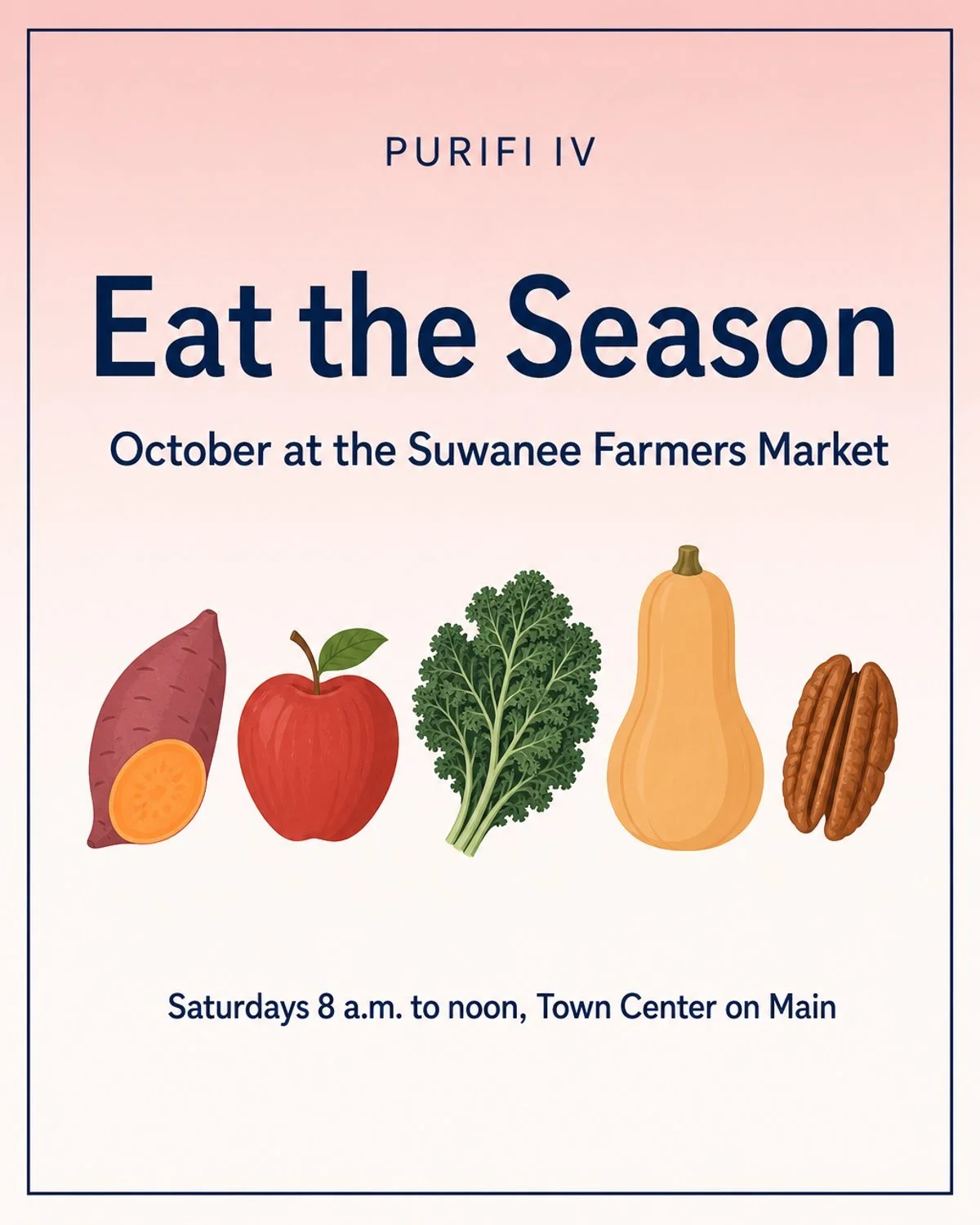
Eat the Season in Suwanee: A Fall Farmers Market Guide to Vitamins, Minerals, and Hydration
Georgia’s fall crops are in and the Suwanee Farmers Market has a few Saturdays left in its summer season. Here’s what’s worth putting in your bag, what each crop brings nutritionally, and where IV vitamin therapy fits.
The Suwanee Farmers Market has only a few Saturdays left in its summer season. Every Saturday in October it runs from 8 a.m. to noon at Town Center on Main and DeLay Nature Park, 421 Main Street, before switching to its shorter winter schedule in November. October also happens to be when Georgia's fall crops arrive, which makes this the best month of the year to eat well without trying very hard.
This guide covers what's in season right now, what those foods actually bring to the table nutritionally, how much of your daily hydration can come from what you eat, and where IV vitamin therapy fits for the people who use it.
What's in Season in Georgia Right Now
Georgia's fall harvest calendar is long. Depending on the week and the vendor, October at a local market usually means apples, pears, pumpkins and winter squash, sweet potatoes, collards and kale, Brussels sprouts, turnips, peppers and pecans. You'll also find local eggs, meat, honey and baked goods at the Suwanee market, which lists more than 40 vendors in a typical week.
Not every farm will have every crop every Saturday. That's part of the point. Buying what's actually coming out of the ground this week keeps your plate varied without a meal plan.
Why Fresh and Local Is Worth the Trip
Some nutrients start breaking down the moment produce is picked. Vitamin C is the most fragile. A widely cited review of fresh, frozen and canned produce found that green peas can lose about half their vitamin C within the first 24 to 48 hours after harvest, and broccoli stored for a week at room temperature lost more than half of its vitamin C. Refrigeration slows those losses a lot.
A short trip from the farm to your kitchen helps. So does eating what you buy within a few days and keeping it cold. The same review found that fresh peas and spinach kept in the fridge for about 10 days ended up with less vitamin C than their frozen versions, so if the market isn't in your Saturday plans, the freezer aisle is a solid backup.
The Nutrients on a Fall Plate
Here's what the headline fall crops bring, using the National Institutes of Health's food composition figures.
Sweet potatoes and winter squash for vitamin A. One baked sweet potato provides about 1,403 mcg of vitamin A, roughly 156% of the Daily Value. The NIH lists vitamin A as important for normal vision, the immune system, reproduction, and growth and development. Winter squash, spinach and broccoli are also on its list of good sources.
Peppers, broccoli and Brussels sprouts for vitamin C. Most people think of oranges first, and a medium orange does provide about 70 mg. But half a cup of raw red pepper has about 95 mg, half a cup of cooked broccoli about 51 mg, and half a cup of cooked Brussels sprouts about 48 mg. Adults need about 90 mg a day for men and 75 mg for women. The NIH describes vitamin C as an antioxidant that the body needs to make collagen, that improves absorption of iron from plant foods, and that helps the immune system work properly.
Garlic, onions, kale and Brussels sprouts for glutathione building blocks. Glutathione is an antioxidant your body makes itself from three amino acids: cysteine, glutamate and glycine. Cysteine is a sulfur containing amino acid and is usually the limiting ingredient. A 2019 review in the journal Nutrients notes that sulfur rich foods, including allium vegetables like garlic and onions and cruciferous vegetables like kale, broccoli and Brussels sprouts, may support the body's own glutathione production. Protein foods such as eggs, poultry and dairy supply the amino acids.
Leafy greens for magnesium. The NIH lists green leafy vegetables such as spinach among good food sources of magnesium, a mineral involved in more than 300 enzyme systems in the body, alongside legumes, nuts, seeds and whole grains. Pecans, which Georgia grows in quantity, count too.
Local eggs and meat for protein. Protein at each meal keeps a fall plate balanced and supplies the amino acids that everything above depends on.
Food Counts Toward Hydration Too
Hydration is usually treated as a glass of water, but the Mayo Clinic notes that food provides about 20% of the total water most people take in each day. Many fall crops are mostly water by weight. According to USDA data, apples are roughly 83 to 85% water, broccoli about 90%, and bell peppers 92 to 94%. Soups and stews made with these vegetables add even more.
For most healthy adults, total fluid needs from all sources land around 11.5 cups a day for women and 15.5 cups a day for men, and they go up with heat, exercise and illness. Eating plenty of produce is an easy way to make that number less of a chore.
Where IV Vitamin Therapy Fits
A varied plate of whole food is the foundation, and it's also the context for how our clients use IV therapy.
IV vitamin therapy delivers fluid, vitamins and minerals directly into the bloodstream, bypassing digestion. That's the key difference from anything you eat or drink. Some of our clients add a drip as part of their routine during demanding stretches, such as a heavy travel month, a busy season at work, or after a long effort when fluids haven't kept up. Others come in for a specific ingredient they've talked through with our provider, such as vitamin C, the B vitamins, or glutathione as an add on.
What IV therapy does not do is replace the food on your plate. It isn't a substitute for vegetables, it doesn't make up for a diet built on processed food, and it does not prevent or cure illness. We think it works best as a complement to the basics in this guide, not instead of them.
Every visit at Purifi IV starts with a real conversation with our medical team, led by local ER professionals, about what's in each bag and whether it fits you.
A Simple Saturday Plan
If you're heading to the market this month, here's a short list that covers most of the ground in this guide:
Two or three sweet potatoes or a winter squash
A bunch of kale or collards
A red pepper and a head of broccoli
Garlic and onions
A dozen local eggs or a protein from one of the meat vendors
A bag of apples for the week
Our first Purifi Kitchen recipe uses almost all of it. Find it, and our other nutrition resources, at purifiiv.com/weight-loss-nutrition. And if you're in the neighborhood after the market, come say hi. We're about ten minutes up Peachtree Industrial.
This post is for general informational purposes and is not a substitute for professional medical advice, diagnosis, or treatment. Always consult a qualified healthcare provider with questions about your health.
References
National Institutes of Health, Office of Dietary Supplements. Vitamin C: Fact Sheet for Health Professionals. https://ods.od.nih.gov/factsheets/VitaminC-HealthProfessional/
National Institutes of Health, Office of Dietary Supplements. Vitamin A and Carotenoids: Fact Sheet for Health Professionals. https://ods.od.nih.gov/factsheets/VitaminA-HealthProfessional/
Mayo Clinic. Water: How much should you drink every day? https://www.mayoclinic.org/healthy-lifestyle/nutrition-and-healthy-eating/in-depth/water/art-20044256
Rickman JC, Barrett DM, Bruhn CM. Nutritional comparison of fresh, frozen and canned fruits and vegetables. Part 1. Vitamins C and B and phenolic compounds. J Sci Food Agric. 2007;87:930-944. https://doi.org/10.1002/jsfa.2825
Minich DM, Brown BI. A Review of Dietary (Phyto)Nutrients for Glutathione Support. Nutrients. 2019;11(9):2073. https://pmc.ncbi.nlm.nih.gov/articles/PMC6770193/
Written and reviewed by Johnathon Nolen, and Dr. Jeremy Nelson.